

The Silent Question That Shapes Every Showing

Homebuyer imagining life inside a staged home during a property showing.
Understanding how buyers visualize a home is central to understanding how decisions are actually made during property viewings. Buyers rarely articulate it, but as they walk through a space, they are continuously engaging in a quiet internal dialogue built around one question: “Where would I sit?”
That question is not really about seating. It is about belonging. It reflects whether a space feels intuitive enough for a buyer to imagine their own life unfolding inside it. According to insights often shared by Jackie Scura, this moment of self-placement is one of the most influential emotional triggers in the entire buying journey. If a buyer cannot immediately see themselves settling into a room, the emotional connection weakens, even if the property checks every practical box.
Buyers Don’t Just Observe a Home, They Enter It Mentally

Cozy home interior designed to help buyers visualize daily living.
To truly understand how buyers visualize a home, it helps to recognize that buyers are not passive observers. They are participants in a mental simulation. Every room becomes a scenario they step into and test against their own lifestyle.
A living room is no longer just a living room. It becomes a question of whether this is where mornings begin slowly with coffee, or where evenings end with conversation and rest. A dining area is not simply measured in size; it is imagined as a setting for gatherings, celebrations, or quiet meals. Bedrooms are evaluated not just for layout, but for how easily they transform into personal retreats from the outside world.
When a space is unclear or emotionally neutral, it interrupts how buyers visualize a home, forcing them to work harder to imagine possibility. Most buyers will not make that effort for long.
The Psychology Behind Visualization and Decision Making


Buyer emotionally connecting with a thoughtfully staged home interior.
There is a deeper cognitive process behind how buyers visualize a home. Human beings rely heavily on mental simulation when making emotionally significant decisions. Before committing to a home, the brain tries to rehearse what life would feel like inside it.
When staging supports this process, the experience becomes effortless. The mind can quickly map routines, habits, and emotions onto the environment. The space feels familiar even on a first visit, which reduces hesitation and builds comfort.
When staging is absent or poorly executed, the opposite happens. The buyer is forced into abstraction. Instead of feeling, they begin analyzing. Instead of imagining life, they start questioning layout, size, and usability. That shift from emotional engagement to logical evaluation often slows or completely halts decision-making.
This is why professionals like Jackie Scura emphasize that staging is not decoration. It is a method of guiding perception so that how buyers visualize a home becomes immediate, natural, and emotionally compelling.
Why Sellers Cannot Afford to Ignore This Mental Process
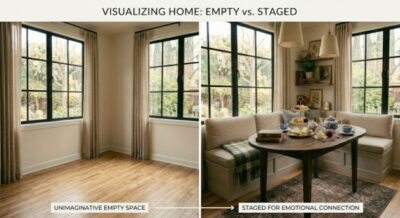
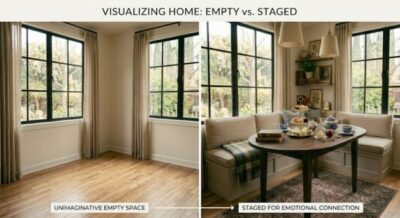
Comparison between empty and staged home showing the impact of staging.
From a seller’s perspective, understanding how buyers visualize a home changes everything about how a property should be presented. A home is not being evaluated as a structure alone; it is being evaluated as a future experience.
Empty or poorly arranged rooms unintentionally force buyers into uncertainty. A blank space does not feel neutral to a buyer—it feels unresolved. Without cues, buyers are left to guess how the space should function, and that guesswork often creates doubt rather than inspiration.
When staging is intentional, every room begins to answer silent questions before they are even asked. A corner that could feel awkward becomes a reading nook. An open space that might feel undefined becomes a natural gathering area. The home begins to communicate clearly, and that clarity directly strengthens how buyers visualize a home in a personal, emotional way.
Creating Spaces That Support Visualization

Well-staged conversation area supporting buyer visualization and comfort.
Effective staging works because it removes ambiguity. It allows buyers to immediately understand not just what a space is, but how it is meant to be lived in. When furniture placement is intentional and proportions are balanced, the home begins to guide the eye naturally from one lived moment to the next.
A well-positioned sofa does more than fill a living room; it tells a buyer where conversation happens. A thoughtfully arranged dining table does more than occupy space; it suggests shared meals and connection. Even subtle styling choices, like lighting or texture, reinforce emotional tone and help shape how buyers visualize a home without requiring explanation.
The goal is not to impress through excess, but to clarify through simplicity. When a home feels easy to understand, it becomes easier to love.
The Emotional Advantage in a Competitive Market

Elegant staged home interior creating emotional impact for buyers.
In competitive real estate markets, emotional clarity often matters more than features. Many homes may offer similar layouts, square footage, or upgrades, but not all of them succeed in shaping how buyers visualize a home in a compelling way.
The homes that stand out are not necessarily the largest or most modern. They are the ones that feel immediately livable. Buyers linger longer in these spaces because they are no longer trying to decode them. Instead, they are experiencing them.
That emotional comfort translates into stronger engagement, better recall after showings, and ultimately faster and more confident offers.
When Visualization Breaks Down

Cluttered home interior affecting buyer perception and emotional connection.
When how buyers visualize a home is disrupted, the entire emotional process slows. Clutter can overwhelm attention and make spaces feel smaller than they are. Overly personalized décor can create distance, making it harder for buyers to imagine themselves in the environment. Poor lighting can flatten mood and reduce emotional warmth, making even beautiful spaces feel uninviting.
These disruptions do not always register consciously, but they influence perception in powerful ways. A buyer may not say “this feels off,” but they will leave with that impression nonetheless.
Final Thoughts
At its core, real estate success is not just about presenting a home—it is about shaping how buyers visualize a home from the moment they walk through the door.
Every space carries a silent question, and that question is always the same: “Where would I sit?”
When a home answers that question naturally, without effort or explanation, it stops being just a property. It becomes a possible life. And in that moment, the decision to move forward becomes significantly easier.
As often emphasized by Jackie Scura, the most powerful homes are not the ones that simply look good—they are the ones that make buyers feel like they already belong.
References
National Association of Realtors – Home Staging Statistics