


Real estate agent discussing home pricing strategy with homeowner
Pricing your home correctly is one of the most crucial decisions you’ll make when selling your property. If your goal is to sell your house fast, the right pricing strategy can make or break your success. Set it too high, and you risk scaring off potential buyers. Set it too low, and you may leave money on the table. In today’s competitive real estate market, learning how to price your home strategically is essential if you want to sell quickly and for the best possible return.
This guide walks you through key pricing strategies, common pitfalls, and tips to ensure your listing stands out from the rest.
Why the Right Price Matters

Home pricing is both an art and a science. The price tag you attach to your home communicates its value to buyers and agents. Overpricing can make your listing stagnate on the market. Underpricing may create a bidding war, but it can also backfire if not managed well.
According to the National Association of Realtors (NAR), the longer a home sits on the market, the lower its final sale price tends to be. This underscores the importance of setting the right price from day one.
Step 1: Understand the Market

House model and compass on plan background, Real estate concept.
Before setting a price, research your local market conditions. Real estate markets vary significantly by location, season, and economic trends.
Analyze Comparable Sales (Comps)
Review similar homes recently sold in your area. These “comps” should match your home’s:
-
Square footage
-
Number of bedrooms and bathrooms
-
Age and condition
-
Location and neighborhood
Use at least 3–5 comps from the past 3–6 months to get a reliable range. If homes similar to yours are selling between $450,000 and $470,000, pricing yours at $525,000 may be unrealistic.
Evaluate Current Listings and Expired Listings
Look at homes currently on the market—these are your competition. Also study expired listings to see what didn’t sell. Expired listings are often overpriced or poorly marketed.
Step 2: Use Online Valuation Tools (But With Caution)
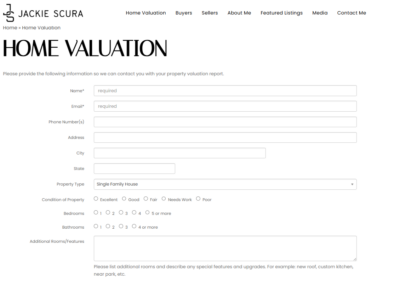
Online home value estimator tools of Jackie Scura
Automated valuation models (AVMs) like Zillow’s Zestimate or Redfin’s Estimate can provide a rough idea of your home’s worth. However, they rely on algorithms and public data, which may not account for unique features, renovations, or market momentum.
Use AVMs only as a starting point. A professional valuation or comparative market analysis (CMA) from a real estate agent will be far more accurate.
Step 3: Hire a Real Estate Agent or Appraiser

Jackie and Dominique Scura your trusted Real Estate Agent
A local real estate agent offers unmatched insight into your neighborhood’s trends and buyer behavior. Most agents will provide a CMA at no cost, as part of their listing service.
Alternatively, hiring a certified appraiser for a pre-listing appraisal (typically $300–$500) gives you an impartial, professional valuation based on in-depth analysis. This can be especially useful in volatile or unique markets.
Step 4: Consider Pricing Psychology
Pricing isn’t just numbers—it’s psychology. Buyers perceive value differently depending on how a price is presented.
Use Strategic Pricing Tactics
-
Avoid round numbers: Pricing at $499,000 rather than $500,000 can feel more approachable.
-
Target search filters: If most buyers in your area search for homes under $500,000, pricing at $505,000 could exclude your listing.
-
Price slightly below competitors: This can make your home look like a better value and generate more showings.
Step 5: Account for Market Conditions
Tailor your pricing to the type of market you’re in:
Seller’s Market
In a hot market with high demand and low inventory, you can price slightly above comps—buyers are more likely to bid aggressively.
Buyer’s Market
When inventory is high and competition is stiff, price competitively or even slightly below market value to attract interest.
Neutral Market
In balanced markets, pricing in line with comparable homes will help you stay competitive without scaring away buyers.
Step 6: Factor in Time Pressure
If you need to sell your house fast—due to a job relocation, financial need, or a contingent offer on another property—pricing your home slightly below market value can speed up the process.
A competitively priced home will typically generate more interest, possibly resulting in multiple offers. The initial two weeks on the market are the most critical. After that, buyer enthusiasm often wanes.
Step 7: Monitor and Adjust
If your home hasn’t received offers within the first 2–3 weeks, re-evaluate the price. Feedback from showings, web traffic stats, and comparisons with similar active listings can reveal misalignments.
Avoid frequent price changes, but be ready to make a decisive adjustment based on data—not emotion.
Bonus Tip: Offer Incentives
If you’re reluctant to lower your price, consider offering closing cost assistance, a home warranty, or flexible move-in dates. These incentives can make your listing more attractive without reducing the price tag.
Common Pricing Mistakes to Avoid
-
Letting emotions dictate value: Your memories aren’t part of the appraisal.
-
Ignoring market feedback: If buyers say it’s overpriced, they’re probably right.
-
Assuming renovations equal value: Not all upgrades yield a return.
-
Pricing based on what you “need”: The market doesn’t care what you owe—buyers focus on value.
Final Thoughts
The right price is the bridge between your home and the right buyer. A strategic, data-driven pricing approach can mean the difference between a listing that lingers and one that sparks a bidding war. When in doubt, lean on professionals, use real market data, and stay flexible.
Selling your home quickly and profitably is absolutely possible—if you start with the right price.
Have questions about selling your home or need help pricing it right? I’d love to guide you through the process.
-
📞 Phone: 973.214.9488
-
✉️ Email: [email protected]